A pallet may arrive before a workstation is ready, wait while another part is processed, then move onward when the receiving route is available. Pallet conveyor accumulation organizes that waiting within the production flow. This guide explains the functional sequence and the conditions to resolve for a proposed buffer.
1. How Pallet Conveyor Accumulation Works
In an assembly line, successive operations rarely have identical timing at every moment. A station may pause for inspection, an operator may take longer on one workpiece, or a downstream transfer may still be occupied. An accumulation area provides planned holding positions between those operations.
As pallets arrive, available positions are occupied. Pallets wait until the receiving process can accept them, then leave in the sequence defined for the application. When the buffer is full, further arrivals must be managed upstream. A buffer absorbs temporary timing differences; it does not increase the processing capacity of a persistent bottleneck.
- ArrivalA pallet reaches the buffer.
- HoldWait in an available holding position.
- Downstream Ready CheckConfirm the receiving path can accept the pallet.
- ReleasePermit onward movement.
- TransferMove into the receiving section or station.
“Hold” describes the waiting condition; “Downstream Ready Check” describes the decision needed before movement resumes. The diagram does not specify whether the conveying medium continues moving, how a carrier is retained or which sensing and control devices are used. Those details belong to the selected mechanical and controls design.
2. Accumulation, Stopping, Positioning and Release Are Different Functions
Accumulation manages a queue
Accumulation concerns the group of pallets waiting along a route: where they can wait, how many can be present and when they can advance. It combines space, load and production-flow requirements.
Pallet stopping holds a carrier
A stopping function arrests or retains a pallet at a defined flow-control point. Its suitability depends on the approaching pallet and operating conditions. The existing documentation does not provide stopper ratings or stopping-force limits.
Process positioning establishes the working datum
Assembly, inspection or testing may need the pallet located and supported against a process datum. Conveyor stopping alone does not define that location or its accuracy. See pallet positioning at process stations for this separate function.
Pallet release permits onward movement
Release ends the holding condition when the next section or station can receive the pallet. Releasing a carrier is distinct from confirming that it has completed the transfer. Both events matter when another pallet is waiting behind it.
3. What the Toshine Platforms Document
All four product pages describe accumulation conveying. The table summarizes that documented scope without assigning a specific accumulation mechanism, control architecture or pressure classification.
On smaller screens, scroll horizontally to compare the platforms.
| Platform | Conveying medium | Documented context | Load interpretation |
|---|---|---|---|
| TOSH-1 | Timing / synchronous belt | Accumulation conveying; named curve, transfer, positioning, lifting and rotation modules are listed. | Published load-rating basis requires factory confirmation. |
| TOSH-2 | 08BS chain | Accumulation conveying; transfer and pallet positioning functions are described, with module selection specific to the application. | 2,200 kg TOTAL conveyor system load; not per pallet. |
| TOSH-4 | 12BS accumulation chain | Accumulation conveying for medium-to-large loads and longer sections. Standard reverse conveying is prohibited. | 2,500 kg TOTAL conveyor system load; not per pallet. |
| TOSH-5 | Roller conveying | Pallet circulation and accumulation; different roller-support and drive arrangements are documented. | Published load-rating basis requires factory confirmation. |
Named TOSH-1 modules do not establish compatibility with TOSH-2, TOSH-4 or TOSH-5. For a comparison of the conveying media themselves, read Timing Belt vs Chain Pallet Conveyor.
4. Define the Buffer Zone and Loaded Pallet Quantity
Count usable holding positions
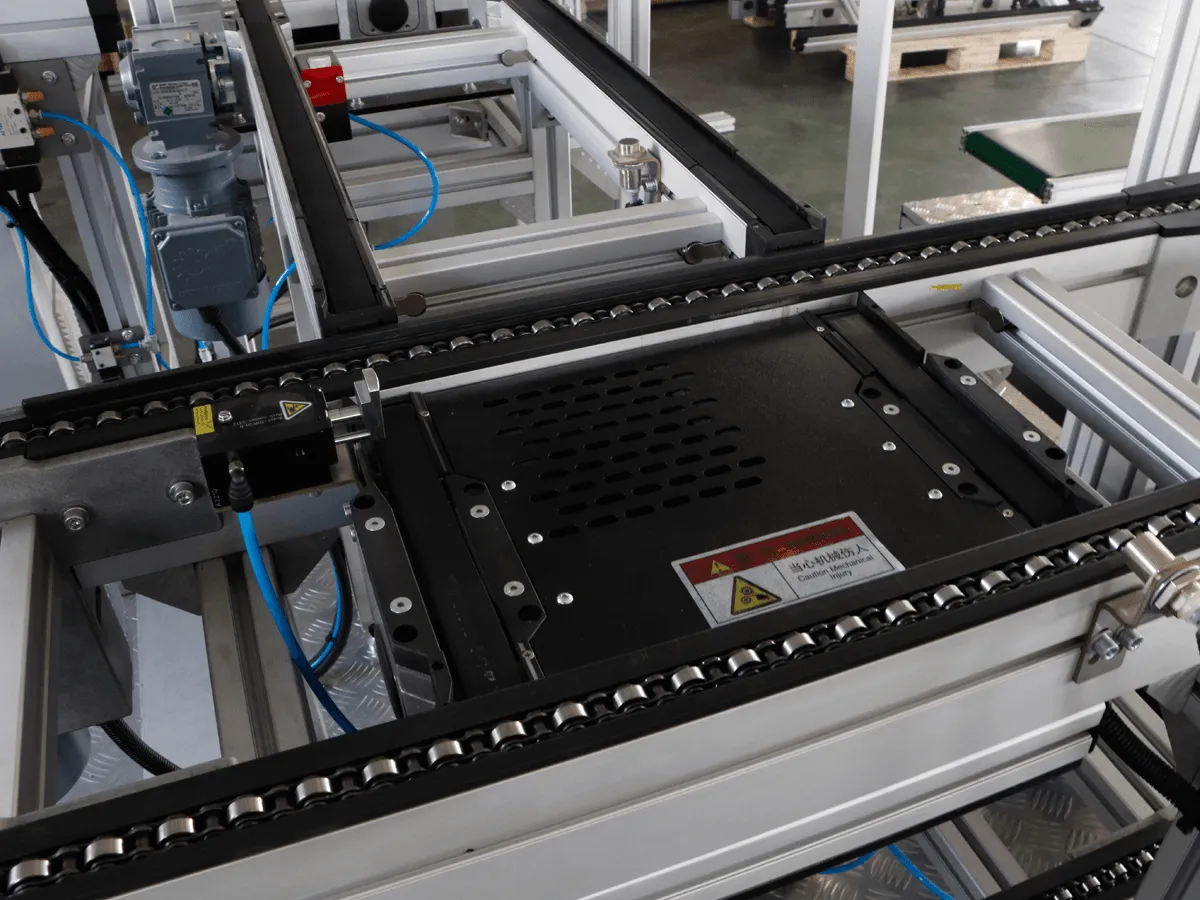
A buffer's physical capacity is the number of pallets that can wait within its usable area while maintaining the required support and clearances. Overall conveyor length is not the same as usable queue length: transfers, access areas and station interfaces may occupy part of the route.
Establish the carrier dimensions in the travel direction, permitted spacing and the boundaries of each holding position. Do not assume pallets can touch or that every visible gap can become a holding position.
Describe normal flow and a full buffer
Show the expected queue during normal operation and the maximum proposed queue during a downstream interruption. Include pallets already at the receiving station or partly across a hand-off. This makes the full-buffer condition visible before the load and control arrangements are selected.
5. Review Total Accumulated Load and Its Distribution
Start with the complete loaded carrier
Individual loaded pallet weight includes the pallet, fixture and workpiece. Add the weights of the carriers that may occupy the proposed buffer together, then identify where those loads act. Mixed workpiece variants may create a different worst case from a queue of identical pallets.
Separate system load from local loading
TOSH-2: 2,200 kg TOTAL conveyor system load.
TOSH-4: 2,500 kg TOTAL conveyor system load.
Neither figure is a maximum load per pallet. Actual capacity depends on conveyor configuration, length, load distribution and operating conditions.
A total system rating does not approve concentrating the same load in one short buffer. Nor does dividing that rating by pallet quantity establish an allowable individual pallet weight. Review the combined queue load, its distribution along the section and support at section boundaries together.
The published load-rating bases for TOSH-1 and TOSH-5 still need factory confirmation. For the broader distinction between carrier load and system capacity, see the selection guide's load-capacity discussion.
6. Connect Buffer Behavior to Production Timing
Follow arrivals through the complete cycle
Consider when pallets arrive, how long the receiving process remains occupied and how much time release and transfer consume. Conveyor travel speed alone does not describe the interval at which a workstation can accept the next carrier.
A steady arrival pattern and a batch arrival can produce different queues even when their average rates are similar. Review process variation and repeated short pauses as well as the nominal cycle. The required buffer should follow those operating scenarios rather than an assumed universal pallet-count formula.
Plan downstream interruptions and recovery
During a downstream pause, the queue grows until arrivals stop or usable positions are filled. Define what happens next: which upstream operation must wait, where carriers remain supported and how the line resumes when the receiving station becomes available.
Recovery also takes time. If arrivals resume as quickly as pallets leave, the queue may remain occupied. Discuss the intended restart and release behavior with the line integrator, including how occupied transfers and partially completed operations are handled.
7. Coordinate Release With Transfer Interfaces
Confirm the receiving path before release
A clear buffer exit does not necessarily mean that a lift, cross transfer or process station is ready. Define receiving availability, the required module position and when a completed hand-off permits the next pallet to advance. Occupancy detection, interlocks and equipment handshakes are project requirements to agree, rather than confirmed standard features.
Maintain support through the hand-off
Review pallet underside geometry, conveying height, clearances and load support as the carrier moves between sections. A carrier held partly across a transfer boundary creates a different support condition from one fully within a straight section. Include that condition in the mechanical review.
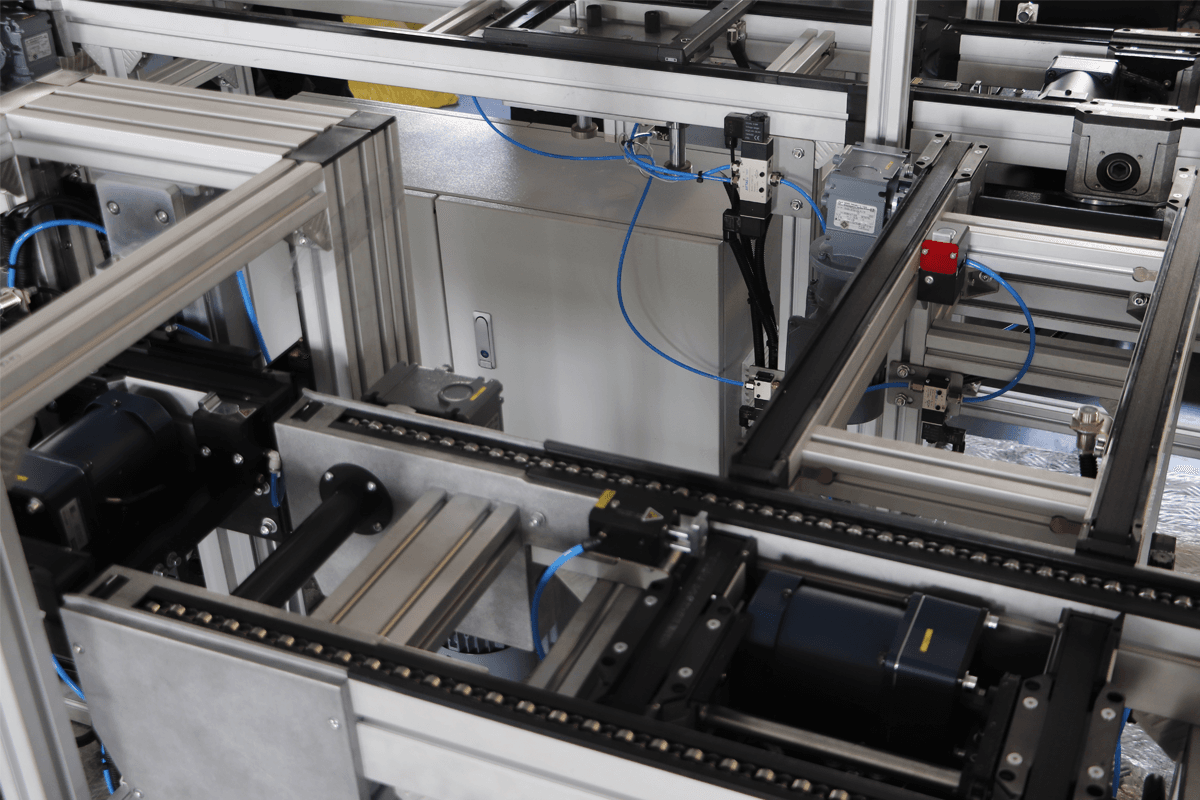
See lift and cross-transfer solutions and pallet circulation systems for the related movements. Confirm each module's suitability for its selected platform and loaded carrier.
Standard TOSH-4 reverse conveying is prohibited. Plan interruption recovery around that restriction; do not assume a queue can be cleared by reversing the conveying section.
8. Confirm the Conditions While Pallets Wait
Holding behavior, contact and dwell
Specify whether contact between pallets is acceptable and what the workpiece and fixture can tolerate. Ask how the proposed configuration behaves while carriers are held, including the motion of its conveying medium. The current product information does not establish friction coefficients, quantified contact forces or zero-pressure accumulation.
Discuss expected waiting periods and repeated hold-and-release operation with the factory. Allowable dwell limits and their implications for wear, heat or lubrication are not published; they should be resolved for the selected arrangement before operation.
Environment and service access
Include contamination, cleaning and access constraints around the buffer. Retained pallets can obstruct maintenance areas, so assess access in the full-buffer state as well as with an empty conveyor. Use the selected equipment's service guidance rather than assuming maintenance intervals from the conveying-medium name.
9. Engineering FAQs
Do pallets have to touch during accumulation?
Not necessarily as a general design principle, but the existing Toshine product information does not specify whether pallet contact is permitted for a particular configuration. Confirm the intended spacing, contact conditions and holding arrangement before specifying the buffer.
Is a pallet stopper the same as a positioning unit?
No. A stopping function holds the carrier at a flow-control point. Process positioning establishes the datum and support needed for the operation. Stopping alone does not establish positioning accuracy or resistance to process forces.
How many loaded pallets can a buffer hold?
The allowable quantity depends on usable holding positions, individual loaded pallet weight, load distribution, section limits and the chosen holding and release arrangement. A conveyor length or total system rating alone is insufficient to approve the quantity.
Can the total system load rating be applied to one accumulated section?
Do not assume so. TOSH-2 has a confirmed 2,200 kg total conveyor system rating and TOSH-4 has a confirmed 2,500 kg total conveyor system rating. Neither is a per-pallet rating or approval to concentrate that load in one section; the proposed distribution needs engineering review.
Does a longer conveyor automatically provide more accumulation capacity?
It may provide more physical space, but allowable pallet quantity also depends on support, drive and holding conditions, accumulated load and transfer clearances. Added length alone does not confirm a higher load or queue limit.
Can a buffer compensate for a slower downstream station?
A buffer can temporarily accommodate differences in arrival and processing timing. It cannot remove a sustained mismatch in average production rates. Once its usable positions are occupied, upstream flow must be managed.
What must be checked before releasing a pallet onto a lift or cross transfer?
Define receiving availability, module position, load suitability, carrier support, clearances and completion of the hand-off before the next release. The required detection, interlocks and recovery behavior must be agreed for the selected equipment; a standard Toshine control sequence is not documented here.
Do Toshine platforms provide zero-pressure accumulation?
The existing product pages document accumulation but do not establish zero-pressure accumulation or quantified pallet contact forces. Specify the required contact behavior and obtain confirmation for the proposed conveyor configuration.
10. Discuss Your Pallet Accumulation Layout
Share a layout showing where pallets arrive, wait and transfer onward. Mark normal and maximum proposed queue quantities, complete loaded pallet weights and their distribution, expected arrival and process timing, and the downstream interruptions the buffer should accommodate.
Include transfer interfaces and any restrictions on pallet contact or waiting conditions. For the wider system definition, use the Pallet Conveyor System Selection Guide; for the belt and chain background, see the platform comparison's accumulation discussion.
Review Your Buffer and Release Requirements
Send your pallet details and production layout to discuss accumulation, loading and the interfaces with your next process.
Discuss Your Accumulation Layout