This article compares TOSH-1 timing-belt conveying, TOSH-2 08BS chain conveying and TOSH-4 12BS accumulation chain conveying. Use it to narrow the platform options. For a broader review of carrier drawings, production layout and project inputs, see the Pallet Conveyor System Selection Guide.
1. How Timing-Belt and Chain Pallet Conveyors Work
Timing-belt transport: TOSH-1
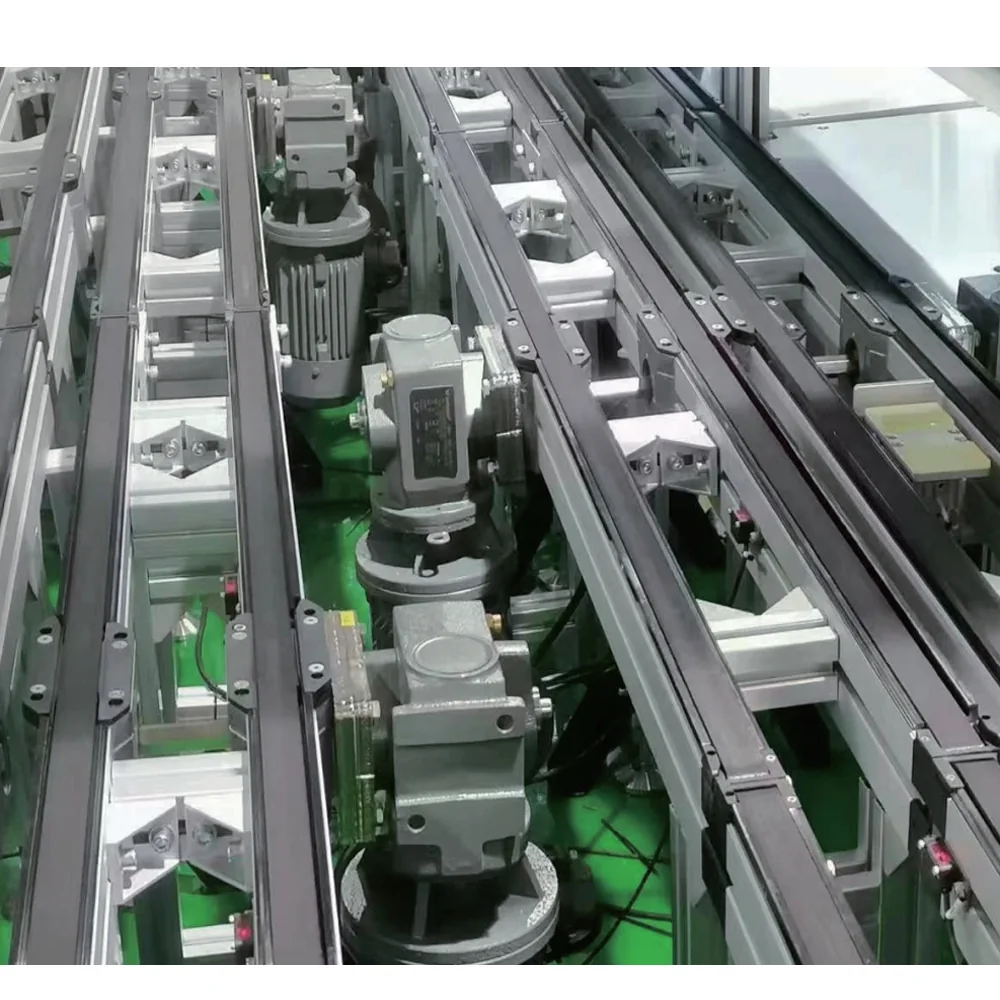
On TOSH-1 Timing Belt Pallet Conveyor, timing belts provide the conveying interface that moves the pallet between stations. The pallet supports the workpiece and fixture; the aluminum-profile structure supports the conveyor arrangement.
Review the carrier underside and support points against the belt-track arrangement. Specify the process station's stopping and positioning arrangement separately from belt transport to define how the carrier is located during assembly or testing.
Chain transport: TOSH-2 and TOSH-4
TOSH-2 Chain Pallet Conveyor uses 08BS chain conveying on a modular aluminum-profile structure. TOSH-4 Heavy-Duty Chain Pallet Conveyor uses 12BS accumulation chain, with the chain tracks and supporting structure configured for the required route and load.
The chain designation identifies the conveying medium. Establish the individual pallet limit and accumulation conditions for the complete configuration.
2. Compare Structure, Pallet Contact and Drive Arrangement
TOSH-1: end-drive or center-drive configuration
The TOSH-1 page documents end-drive and center-drive options. These describe the drive location within the conveyor section. Choose the arrangement around the layout and installation requirements. Any performance difference between drive locations is application-dependent and remains to be confirmed.
TOSH-2: configurable 08BS chain options
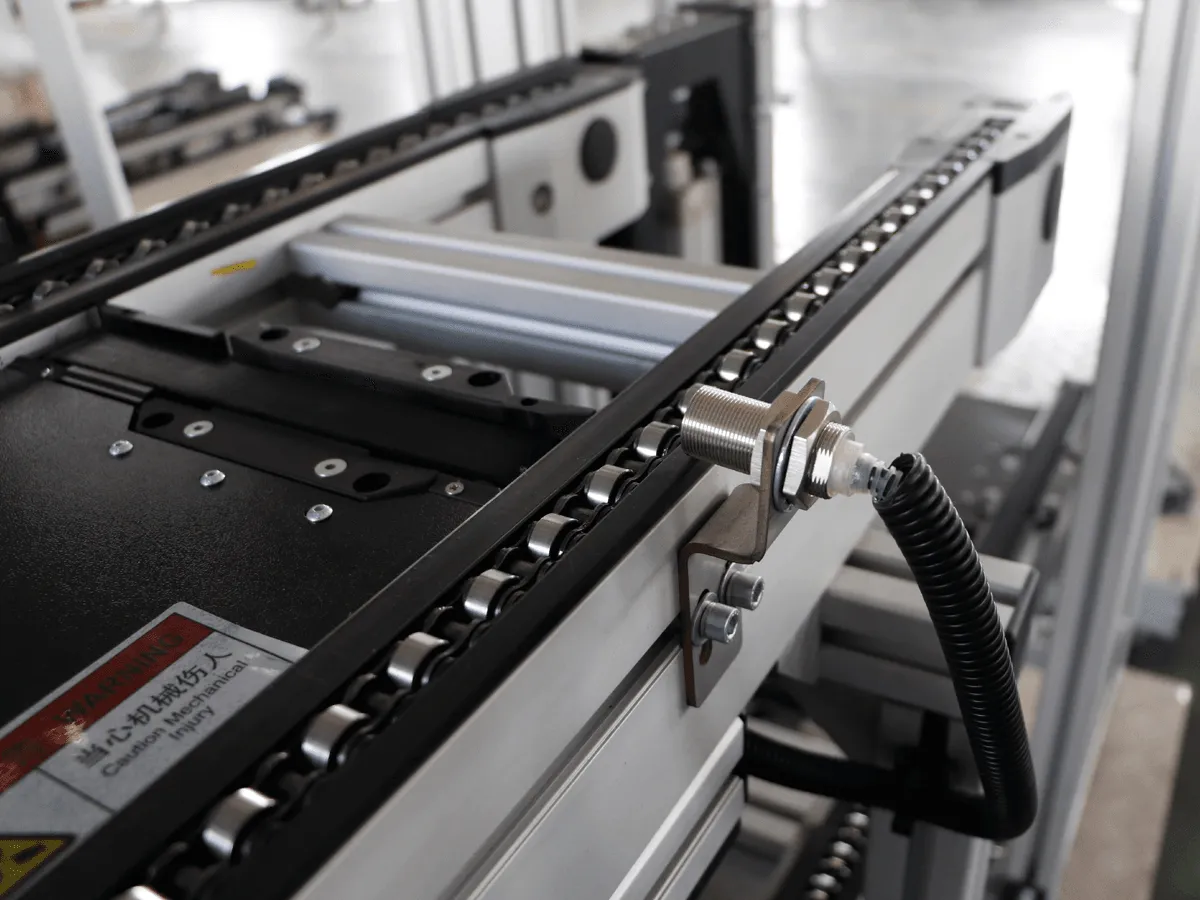
TOSH-2 lists Steel Wheel Chain, Nylon Wheel Chain, Maintenance-Free Nickel-Plated Chain and Chain with Protective Cover. These are options to review against the application. Confirm their interfaces and service conditions rather than treating their names as quantified durability or maintenance guarantees.
TOSH-4: 12BS accumulation chain and drive interfaces
TOSH-4 is positioned for medium-to-large loads and longer conveying distances. Its chain tracks, pallet support and sprocket/drive interfaces must be evaluated together with the effective section length and accumulated load.
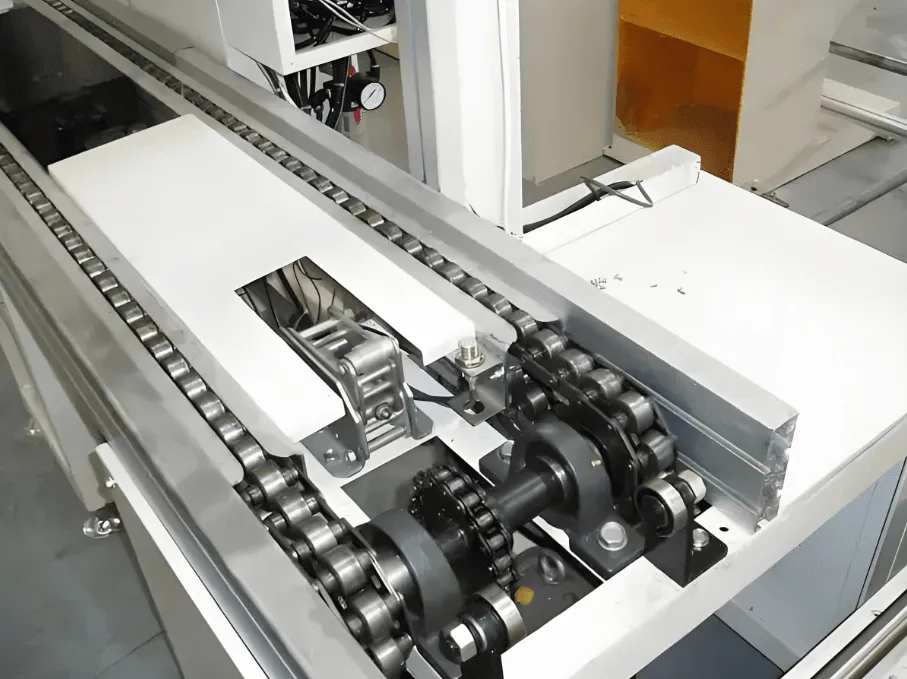
Across all three platforms, inspect how the pallet transfers load into the conveying tracks and how it is supported at section ends and hand-offs. A structural ranking would need common frame-rigidity test conditions and material-section specifications, which are not provided.
3. Timing Belt vs Chain Pallet Conveyor Comparison
The following values are stated on the existing product pages. Load definitions include the confirmed total-system basis for TOSH-2 and TOSH-4.
On smaller screens, scroll horizontally to compare the platforms.
| Parameter | TOSH-1 | TOSH-2 | TOSH-4 |
|---|---|---|---|
| Conveying medium | Timing / synchronous belt | 08BS chain | 12BS accumulation chain |
| Structure | Aluminum-profile frame | Modular aluminum-profile structure | Heavy-duty chain-track structure |
| Drive information | End drive / center drive | Motor position and direction configured for arrangement | Motor position and direction configured for arrangement |
| Conveyor length | 400–6000 mm | 600–12000 mm | 1000–20000 mm |
| Pallet width | 160–1200 mm | 160–1200 mm | 400–1600 mm |
| Published speed | Max. 20 m/min | Max. 20 m/min | Max. 20 m/min |
| Accumulation | Supported | Supported | Supported |
| Load interpretation | Published rating basis requires factory confirmation | 2,200 kg TOTAL conveyor system load; not per pallet | 2,500 kg TOTAL conveyor system load; not per pallet |
| Reverse conveying | Possible with reduced capacity; forward recommended | Separate application evaluation required; forward recommended | Prohibited for the standard configuration |
Treat the published ranges as configuration boundaries, not a guarantee that every maximum can be combined. Confirm the intended combination of length, width, speed and load with the factory.
4. Compare Load Ratings on the Same Basis
Individual loaded pallet weight
Count the pallet, fixture and workpiece together. This is the weight carried by one carrier, with its support points and load distribution. It is distinct from the combined load carried by the conveyor system.
Total conveyor system load
TOSH-2: 2,200 kg TOTAL conveyor system load.
TOSH-4: 2,500 kg TOTAL conveyor system load.
Neither figure is a maximum load per pallet. Actual capacity depends on conveyor configuration, length, load distribution and operating conditions.
TOSH-1's published load-rating basis requires factory confirmation. Its figure should not be compared with the chain-platform system ratings as if all three described the same load case. Likewise, dividing a total system rating by the pallet count does not establish an allowable individual pallet load.
For the wider load-definition and support review, refer to the system selection guide's load-capacity section.
5. Accumulation and Production-Line Integration
Define the buffer condition
All three platforms describe accumulation conveying. Specify how many loaded pallets may stop together, where they wait and how they are released. Review the combined load over the effective conveying length and the timing of the next station.
Confirm accumulation contact forces and allowable dwell conditions for the selected belt or chain arrangement. The published information leaves these values unspecified and provides no basis for ranking buffer performance.
Confirm transfers and process positioning
TOSH-1 lists curve, transverse-transfer, positioning, lifting and rotation modules. TOSH-2 and TOSH-4 describe handling functions for evaluation, but compatibility with the same named TOSH-1 module models is not established. Review the carrier interface, transfer height and load at each connection.
Conveyor stopping controls material flow; process positioning locates the carrier for the operation. Specify the required datum, process forces and locating requirements. Review pallet handling solutions for the different movements involved.
6. Forward and Reverse Conveying Considerations
- TOSH-1: reverse operation is possible with reduced conveying capacity; forward conveying is recommended. The reduction is not quantified.
- TOSH-2: forward conveying is recommended. Reverse conveying requires separate application evaluation.
- TOSH-4: reverse conveying is prohibited for the standard configuration.
Identify any reversing requirement before fixing the production layout. A pallet return route or change in travel direction may require a separate conveyor path or handling arrangement rather than reversal of the conveying section.
7. Maintenance and Operating Conditions to Review
Inspection and service access
For a proposed TOSH-1 arrangement, ask the factory which belt-condition, tracking and tension checks apply and how belts and drive components are accessed for service. For TOSH-2 and TOSH-4, request the applicable chain-wear, lubrication and replacement requirements for the chosen chain arrangement.
Use the factory guidance to define maintenance procedures for the selected arrangement. Service intervals, replacement life and comparative maintenance cost are not specified in the current product pages.
Chain options and the operating environment
The TOSH-2 option named Maintenance-Free Nickel-Plated Chain requires confirmation of its intended conditions and maintenance scope. That name does not make the complete conveyor maintenance-free. Include contamination, cleaning requirements, duty and access restrictions when requesting configuration advice.
Noise and positioning comparisons
Do not infer that timing belts are universally quieter or more accurate than chains. The published information does not establish a controlled noise comparison or numerical positioning accuracy. Comparable measurement conditions and the complete station configuration are needed before making those claims.
8. Which Platform Should You Consider?
Evaluate TOSH-1 for compact-carrier automation
Consider the timing-belt platform for compact carriers and smaller/lighter workpiece applications where its carrier interface and drive arrangements fit the layout. Confirm the load-rating basis and any required handling-module limits.
Evaluate TOSH-2 for moderate-load assembly and accumulation
Consider the 08BS chain platform for multi-station assembly with accumulation. Compare chain options, carrier support and the section configuration against the required buffer and transfer conditions.
Evaluate TOSH-4 for medium-to-large loads and longer sections
Consider the 12BS accumulation-chain platform when the required conveying sections and load arrangement fit its documented application direction. Preserve its standard reverse-conveying restriction when planning the route.
These are starting points for evaluation, not numerical boundaries between products. Application categories overlap, so the workpiece and conveyor configuration should guide the choice.
9. Engineering FAQs
What is the main difference between timing-belt and chain pallet conveying?
The pallet travels on a different conveying medium: timing belts on TOSH-1, 08BS chain on TOSH-2 and 12BS accumulation chain on TOSH-4. The carrier contact surfaces, drive arrangement and operating configuration must be evaluated together.
Can both timing-belt and chain platforms support accumulation?
Yes. All three product pages describe accumulation conveying. The number of stopped pallets, combined load, buffer arrangement and release sequence still require confirmation for the selected configuration.
Does chain conveying always provide greater load capacity?
No general ranking follows from the mechanism alone. TOSH-2 and TOSH-4 have confirmed total system ratings, while the basis of the published TOSH-1 load figure requires factory confirmation. These figures are not directly comparable per-pallet capacities.
Are timing-belt pallet conveyors inherently more accurate or quieter?
The existing product information does not establish either universal advantage. Process positioning depends on the selected locating and support arrangement. A meaningful noise comparison requires comparable measurement and operating conditions.
Can these conveyors run in reverse?
TOSH-1 reverse conveying is described as possible with reduced capacity. TOSH-2 requires separate evaluation. Reverse conveying is prohibited for the standard TOSH-4 configuration.
Does a maintenance-free chain option mean maintenance-free equipment?
No. Maintenance-Free Nickel-Plated Chain is a named TOSH-2 option. Its applicable service conditions and maintenance requirements need confirmation, and the name does not remove inspection or maintenance requirements for the complete conveyor.
Can the same transfer and positioning modules serve every platform?
Compatibility must be checked for the selected conveyor and carrier. TOSH-1 lists named handling modules, but the TOSH-2 and TOSH-4 pages do not establish compatibility with those same module models.
10. Discuss Your Conveyor Configuration
To compare belt and chain options, share your carrier drawing, complete loaded pallet weight, expected accumulation layout, travel direction and operating conditions. Include any fixed station interfaces or handling functions.
For the broader system-planning inputs, use the engineering inquiry checklist in the selection guide.
Review the Belt or Chain Platform for Your Application
Send your pallet details and production layout to discuss a suitable conveyor configuration.
Discuss Your Conveyor Configuration